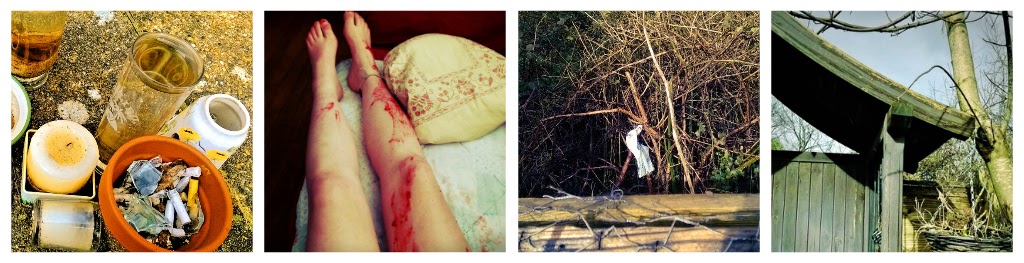
Thursday, 1 May 2014

http://www.mackbooks.co.uk/books/58-Casa-de-Campo.html


Antonio M. Xoubanova
Casa de Campo

“Someone was here, somebody did this. Stuff happens here.”
Casa de Campo is a photographic fable rooted firmly in the realities of Madrid’s largest public park. Casa de Campo sprawls, five times the size of Central Park, to the west of Madrid. Between 2008 and 2012 Antonio M. Xoubanova wandered the paths of this urban woodland examining the people, animals and objects he saw as if he was on uncommon ground. Inadvertently he found himself transforming a given reality into narrative fiction.
Designed as an ancient fairy tale, the book is made up of five chapters referring respectively to love, death, fleeting moments, symbols and a lack of direction. It examines both the symbolic and the oneiric through the gathering together of people, animals, animate and inanimate beings within this single space. In his text Luis Lopez posits that for any researcher, archaeologist, intruder or anthropologist their findings will always be the same: someone was here, somebody did this. Stuff happens here.
These traces are what drew Xoubanova back into Casa de Campo over the years.

His work is very different to mine, however I feel showing the image as a actual narrative incredibly interesting. He has replaced the words with photographs. a literal representation of the written word and the idea that an image is worth more then a 1000 words. 

Roe Ethridge


 When an image is freed of its caption, it becomes a different object and has new terms of use. For me, it’s like it might have failed in relation to all this other stuff, so this commissioned image gets designated: "Don’t throw it away, but just forget about it." And then two years later it’s like, "What was the problem with it? I really like this one now." But I would say today that I’m just much busier because it’s going good, and I’ve sort of embraced a lot more. I did a pinup story for a German magazine, which was essentially an excuse to photograph this studio, this building – which may or may not get torn down in a month – but to do it retro with pretty girls in bikinis or whatever.

<em>Untitled (Canyon)</em>, 2012<em>Untitled (Nipple)</em>, 2013<em>Untitled (Hair)</em>, 2012

CAN ARTIST WHITNEY HUBBS MAKE THE ORDINARY MEANINGFUL?


At first glance, her subject matter seems quite ordinary. But as time passes, the elements of light and dark begin to draw the viewer deeper into her composition. The sexual undercurrent that permeates her work is especially evident in Untitled (Horse), which is beautiful, yet ever so slightly uncomfortable to linger on.
Hubbs prefers her viewers to come to their own conclusions about her work. Her understated approach allows a certain openness. “I’m just going to keep taking pictures and see what happens,” continues Hubbs, “I give myself over to my intuition and what’s in front of me, so I don’t have a set plan.”


Ron Jude

Alpine Star

Jude_Alpine044 thumbnailJude_Alpine006 thumbnailJude_Alpine055 thumbnail

Based on a sequence of pictures culled from the back-issues of a small town newspaper, Alpine Star by Ron Jude engages with the fictions of our collective memory. We find at work something far stranger than the standard assault on a photographic “code” that has undermined most discussion of the subject. This is not just another deconstruction of photography as if it were a kind of conceptual problem to be solved and explicated, but rather an irrational poetics of the archive. Jude has fashioned an uncanny anti-narrative, its precise structure defined by a tension native to photography itself. The result is more than just the sum of its parts – he achieves, in this minimal way, a very satisfying and provocative ambiguity.
—Darren Campion
The Incoherent Light

Emmett 

Jude_emmett_004 thumbnailJude_emmett_028 thumbnailJude_emmett_030 thumbnail
Originally photographed by Ron Jude in central Idaho in the early 1980s and forgotten for nearly three decades, the images in emmett range from hazy scenes of a summertime drag race, midnight horror films on a TV set, and a Nordic-looking teenager who appears as a specter from his past. Reconsidered here as a “new” body of work, these early photographic efforts—vernacular in tone, lacking in irony or pretense, enhanced by cheap filters and telephoto lenses—now resonate with unexpected menace and melancholy, building on Jude’s fundamental interest in exposing “the folly of rational thought” through fragmentary photographic narratives.


Related conceptually and residing thematically between two previous bodies of work, Alpine Star and Other Nature, emmett explores our desire to give structure and assign meaning to our memories, and our inability
to ever fully know or understand ourselves through self-reflection. As Jude brings coherence to his own
unintended “series” of emotionally charged pictures, the everyday notion of the past collides with the more
philosophical and improbable idea of The Past, creating a tension between our sentimental engagement
with photographs, and the nagging sense that it’s all just an illusion. Through nuanced editing and a
purposeful exploitation of his own photographic mistakes, Jude fleshes out and finesses this tension into
 something palpable—an aesthetic inspired by equal parts Motörhead and Jean-Paul Sartre.

scissorsandroach thumbnailNausea_8 thumbnailNausea_12 thumbnail

Nausea

Nausea—taken from the title of Sartre’s book— is a remarkable body of photographs using the interiors
 of schools to explore what Jude calls ‘psychic oppression’. Using a highly original visual language,
this first show of Jude’s work in Britain includes some of the most intriguing images to emerge
from America in recent years.
…Jude appears to be returning to the scene of a crime—peering
through windows, doorways, and iron grilles into deserted rooms and corridors. Avoiding sentimentality,
 Jude trains his camera on the mundane, recalling the banality of humdrum life.
Jude’s photographs
have an affinity with William Eggleston’s most vital work. In place of obvious pictorial
devices he employs radical framing and narrow focus. With an immaculate eye for colour,
he invests, each scene with a tension and unease that brings to mind the films of David Lynch.
—David Chandler, Senior Curator
The Photographers’ Gallery, London, 1992

People may say that Ron Judes images may be boring, or too simple, I however find his simplicity very beautiful. Little snatches of what we see in everyday life that we may take for granted, things that we may see but store away far in our mind never thinking about it again. I find this approach incredibly refreshing for I like to find beauty within the simple. I was worried that my photographs may seem too plan however seeing these I realize that I should stick with that I persevere to be beauty. 


Tuesday, 8 April 2014


I have been researching different way to show my work for the degree show, I have decided i'd quite like to show my work in either three or four's. Based on this idea I have spent the time making collages to see what photos would most fit what I am trying to portray. Here is just a few.


A Catch Up Blog


Theory

Ellipsis (Narrative device) 
Sex theory and feminism - have reversed the roles and portrayed man as object
The subversion of the hegemony of male dominance in western society 
Carl Jung's archetypes -  focusing on archetypes that we find in fairy tales or other film and literature, Focusing on his Anima, Animus and The Shadow archetypes.
The Gaze

Interpretation

Primary interpretation – what I want you to see and what narrative I want you to construct
Secondary – what the audience interpret. 

Main Artists
Cindy Sherman.
Anna Gaskell
                                                           Jane Burton                                                                  


Wednesday, 12 March 2014


These are a few of my favorite images that I have taken in the last couple of days. I have edited them in a way to make the color pop out, vibrant reds, oranges and gold symbolizing lust and power.This time I do not have a literal human being involved, Instead  I have just used artifacts, furs, lamps. jewels etc. A abstract representation of the struggle of power between the male animus and the female anima.